5 Day 5 (February 3)
5.1 Announcements
Activity 1.
- “What did you do?”
- Comment about giving me just R code
- Comment about ggplot and prediction intervals
- Comment about automation, AI, etc.
The first part of Activity 2 is posted
Read and re-read pgs. 10-14 of Spatio-temporal statistics with R.
Questions/clarifications from journals
- A lot of this is covered in 6.3 and 6.4 of the book (pgs. 268-284)
- “In class today, I learned that predictive accuracy in time series forecasting is not just about getting a close point estimate, but also about whether the forecast distribution is reasonable.”
- “Following up on the cross-validation discussion, I didn’t fully understand why a model would be considered good when, during calibration, 95% of the estimated data points fall within the prediction interval (PI).”
- “Something that I am struggling to understand from within the past 24 hours is what kind of spatio-temporal methods are we supposed to try on the final project? Are we supposed to choose a method from the textbook ourselves or are we going to discuss some common methods in class?”
- “Can we assume that the model with the lowest AICc would have the best predictive accuracy?” (See Gelman paper for quote)
- “I think I’m a little confused about the difference between calibration and cross validation.”
- Trevor’s thoughts about cross validation and information-based criteria for model selection/evaluation of predictive performance
5.2 Distribution theory review
Probability density functions (PDF) and probability mass functions (PMF)
- Normal distribution (continuous support)
- Binomial distribution (discrete support)
- Poisson distribution (discrete support)
- And many more
Distributions in R
- PDF of the normal distribution \[[z|\mu,\sigma^2] = \frac{1}{\sqrt{2\pi\sigma^2}}\textit{e}^{-\frac{1}{2\sigma^2}(z - \mu)^2}\]
- \(z\) is the random variable
- \(\mu\) and \(\sigma^2\) are the parameters
- PDFs & PMFs in R
?dnorm
- Generate random variables (\(z\)) from a PDF (e.g., \(z_i\sim\text{N}(\mu,\sigma^2)\))
## [1] -0.84627416 0.02495257 1.74171022 -0.23060488 0.53893943- Histogram representation of a PDF
library(latex2exp)
z <- rnorm(n = 10000, mean = 0, sd = 1)
hist(z,freq=FALSE,col="grey",main = "",
  xlab= TeX('$\\textit{z}$'),
  ylab = TeX('$\\lbrack\\textit{z}|\\mu,\\sigma^2\\rbrack$'))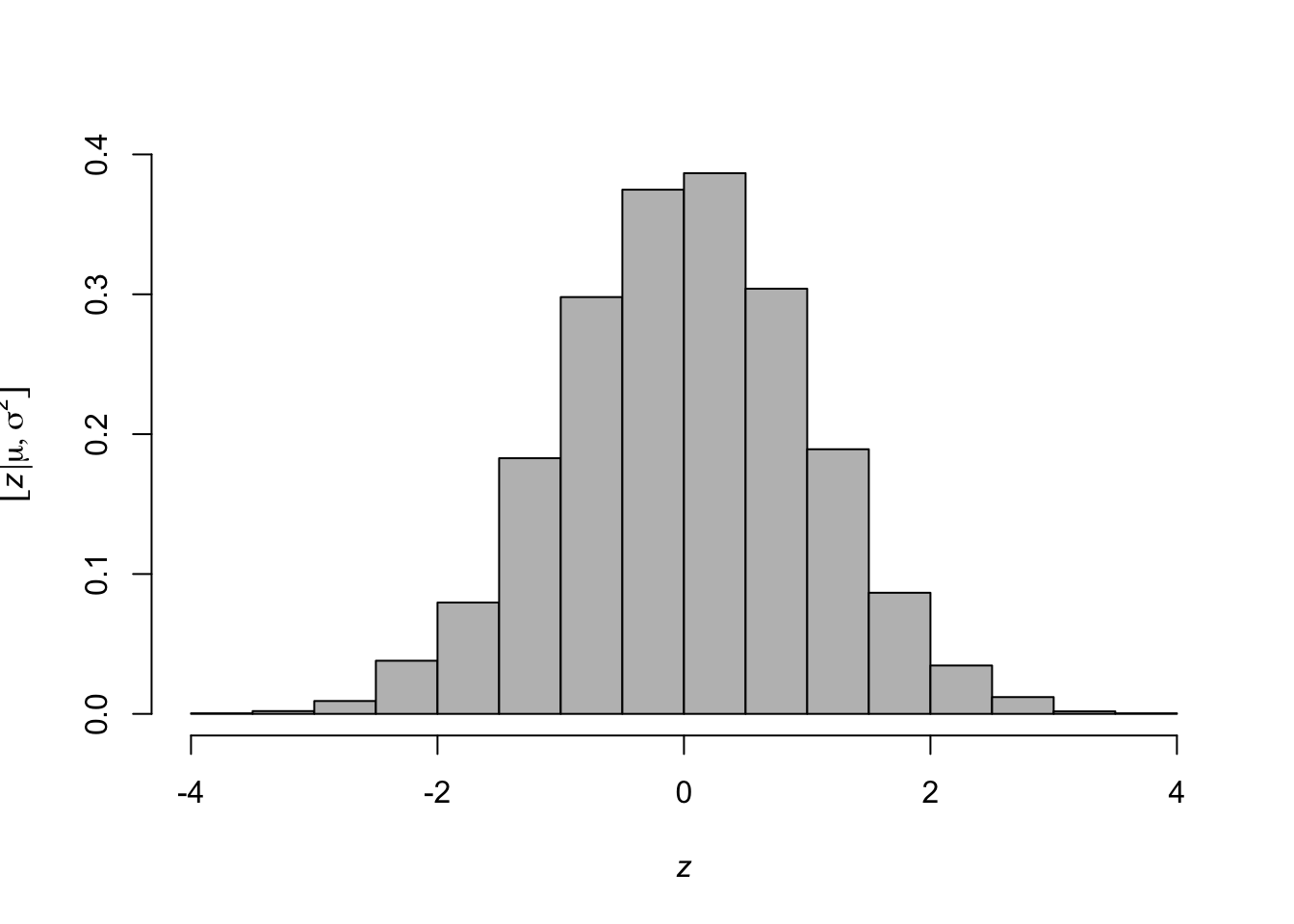
- Plot a PDF in R
curve(expr = dnorm(x = x, mean = 0, sd = 1), from = -10, to = 10,
  xlab= TeX('$\\textit{z}$'),
  ylab = TeX('$\\lbrack\\textit{z}|\\mu,\\sigma^2\\rbrack$'))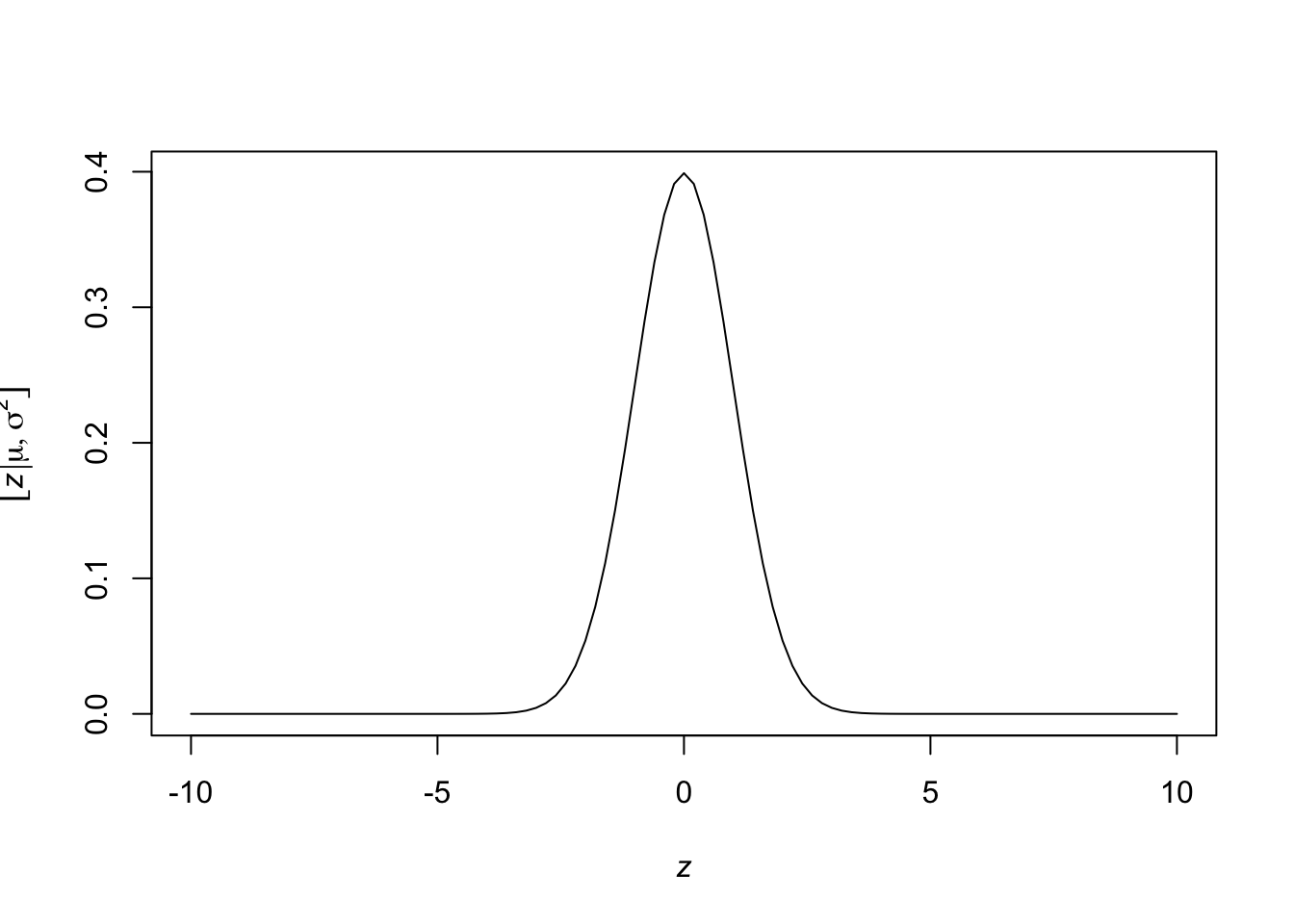
- Evaluate the “likelihood” at a given value of the parameters
## [1] 0.08492566- Other distributions
rpois(n = 5, lambda = 2) rbinom(n = 5, size = 10, prob = 0.5) runif(n = 5,min = 0,max = 3) rt(n = 5,df = 1) rcauchy(n = 5, location = 2, scale = 4)- See stats package for more information
- PDF of the normal distribution \[[z|\mu,\sigma^2] = \frac{1}{\sqrt{2\pi\sigma^2}}\textit{e}^{-\frac{1}{2\sigma^2}(z - \mu)^2}\]
Making your own functions for a distribution
- PDF of the exponential distribution \[[z|\lambda] = \lambda\textit{e}^{-\lambda z}\]
- Make your own function for the PDF of the exponential distribution
- Make your own function to simulate random variables from the exponential distribution using the inverse probability integral transform
- Make histogram by sampling from
rexp()and overlay the PDF usingdexp()
z <- rexp(n = 10000, lambda = 1)
hist(z,freq=FALSE,col="grey",main = "",
  xlab= TeX('$\\textit{z}$'),
  ylab = TeX('$\\lbrack\\textit{z}|\\lambda\\rbrack$'))
curve(expr = dexp(z = x,lambda = 1), from = 0, to = 10,
  add = TRUE,col = "deepskyblue",lwd = 3)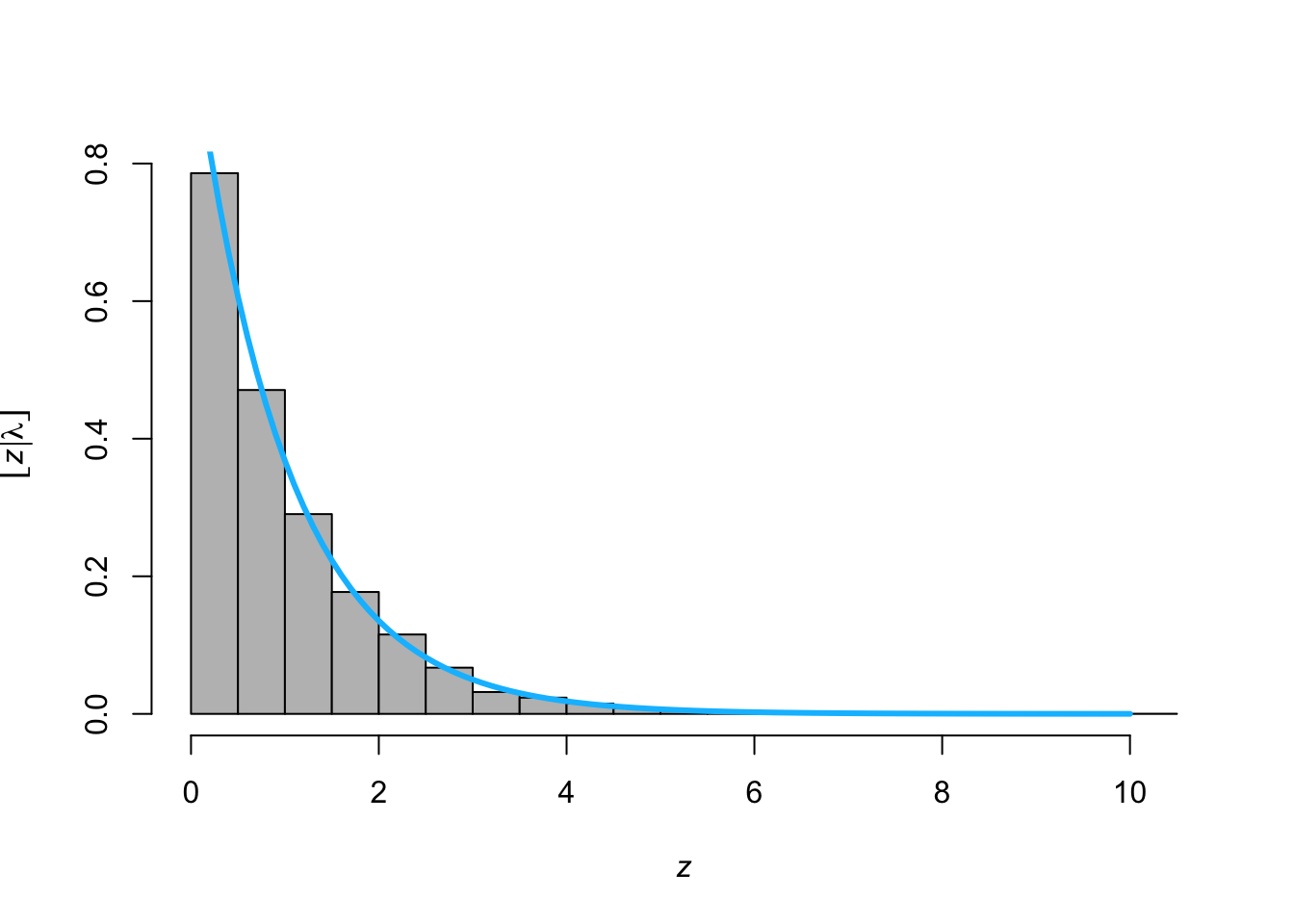
Moments of a distribution
- First moment: \(\text{E}(z) = \int z [z|\theta]dz\)
- Second central moment: \(\text{Var}(z) = \int (z -\text{E}(z))^2[z|\theta]dz\)
- Note that \([z|\theta]\) is an arbitrary PDF or PMF with parameters \(\theta\)
- Example normal distribution \[\begin{eqnarray} \text{E}(z) &=& \int_{-\infty}^\infty z\frac{1}{\sqrt{2\pi\sigma^2}}\textit{e}^{-\frac{1}{2\sigma^2}(z - \mu)^2}dz\\&=& \mu \end{eqnarray}\] \[\begin{eqnarray} \text{Var}(z) &=& \int_{-\infty}^\infty (z-\mu)^2\frac{1}{\sqrt{2\pi\sigma^2}}\textit{e}^{-\frac{1}{2\sigma^2}(z - \mu)^2}dz\\&=& \sigma^2 \end{eqnarray}\]
- Example exponential distribution\[\begin{eqnarray} \text{E}(z) &=& \int_{0}^\infty z\lambda\textit{e}^{-\lambda z}dz\\&=& \frac{1}{\lambda} \end{eqnarray}\]\[\begin{eqnarray}\text{Var}(z) &=& \int_{0}^\infty (z-\mu)^2\lambda\textit{e}^{-\lambda z}dz\\&=& \frac{1}{\lambda^2} \end{eqnarray}\]
Revisiting the cars example[(Download example here)]