7 Day 7 (February 10)
7.1 Announcements
- Donuts on Thursday
- About 20-30 min at end of class to meet your peers!
- Read and re-read pgs. 10-14 of Spatio-temporal statistics with R.
- Review distribution theory notes
- Review mathematical modeling notes
- Questions/clarifications from journals
- “Can agent-based models account for uncertainty? Or are they purely deterministic?” (see here)
- “Today I learned that statistical results don’t come directly from the data alone, they come from the assumptions we build into a model….Overall, I’m starting to see modeling less as picking a method and more as building a reasonable set of assumptions for the situation.”
- “In agronomic data, including random factors often feels conceptually reasonable, but I am not clear on how to evaluate whether the added structure is truly improving the model or simply introducing bias through additional assumptions. For example, if a random effect seems biologically meaningful, is that alone enough reason to include it, or should the decision be based on statistical criteria?”
7.1.1 Motivating data example
Data set
url <- "https://www.dropbox.com/scl/fi/kxzc8fmomkigcrxyjjmdp/Butler-et-al.-Table-1.csv?rlkey=61ey3q1jc4rsor257uy4080j3&dl=1"
df1 <- read.csv(url)

plot(df1$Winter, df1$N, xlab = "Year", ylab = "Population count (z)", xlim = c(1940,
    2020), ylim = c(0, 300), typ = "b", cex = 0.8, pch = 20, col = rgb(0.7, 0.7,
    0.7, 0.9))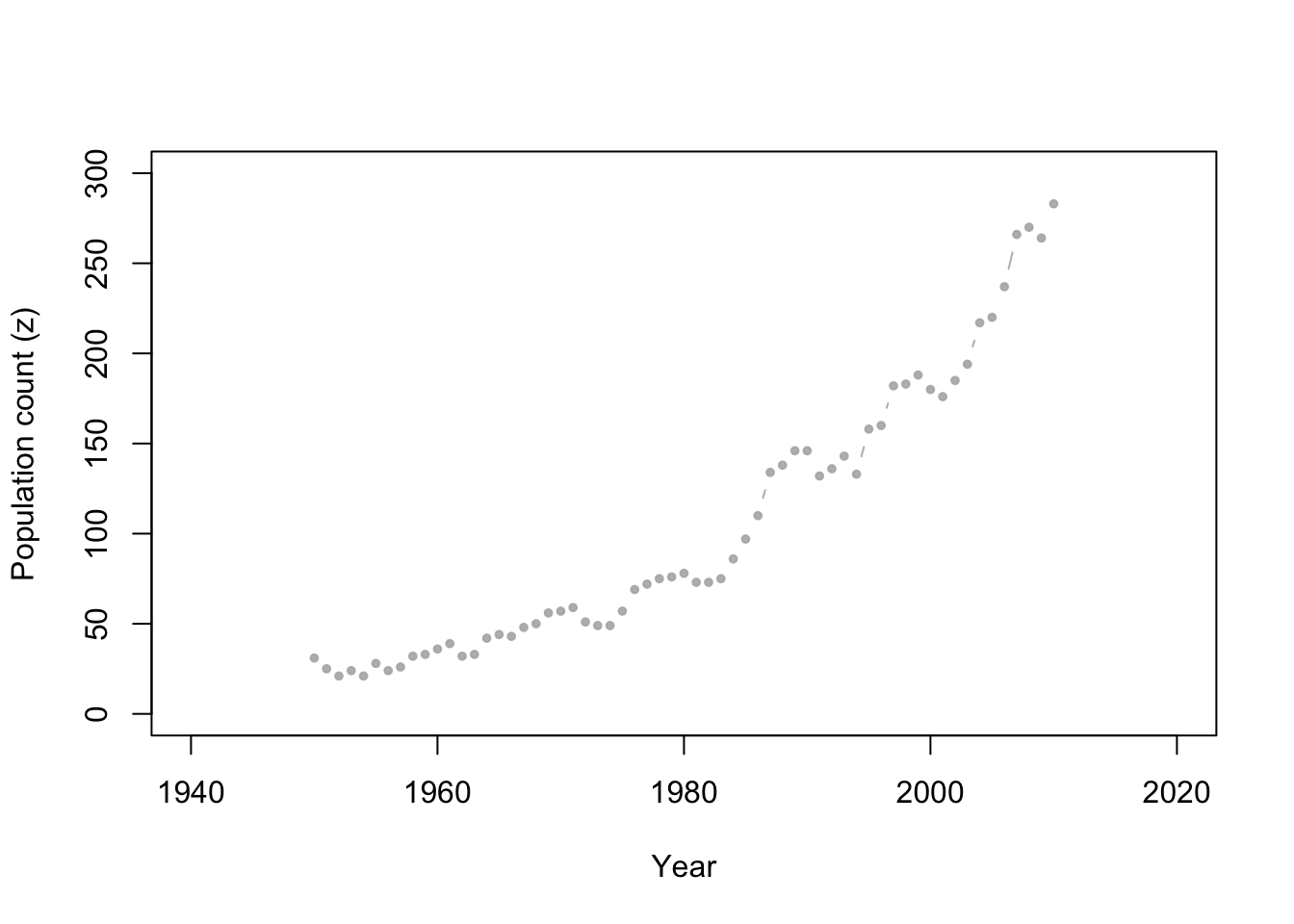
Live example Download R code here
We want to build a statistical model that enables
- Predictions and forecasts of the true population size
- Statistical inference on the date when the population will be larger than 1000 individuals
Points to consider
- Whooping cranes are counted from an airplane (could some individuals be missed?)
- Aggregation of a spatio-temporal point pattern?
- Are there any existing models that could work for these data?
- Anything else?
Mathematical model for whooping crane data
- Ordinary differential equations
- The expected number of whooping cranes at any given time can be calculated by\[\lambda(t+\Delta t)=\lambda(t)+b(t)-d(t)\:.\]At time t, let the births equal \(b(t)=\beta\Delta t\lambda(t)\) and deaths equal \(d(t)=\alpha\Delta t\lambda(t)\). Then write the equation above as \[\lambda(t+\Delta t)=\lambda(t)+\beta\Delta t\lambda(t)-\alpha\Delta t\lambda(t)\:.\] Now define the growth rate as \(\gamma=\beta-\alpha\) and rewrite as \[\lambda(t+\Delta t)=\lambda(t)+\gamma\Delta t\lambda(t)\:.\] Next write the equation as\[\frac{\lambda(t+\Delta t)-\lambda(t)}{\Delta t}=\gamma\lambda(t)\] and let \[\Delta t\rightarrow0\lim_{\Delta t\rightarrow0}\frac{\lambda(t+\Delta t)-\lambda(t)}{\Delta t}=\gamma\lambda(t)\:.\] Finally replace \(\lim_{\Delta t\rightarrow0}\frac{\lambda(t+\Delta t)-\lambda(t)}{\Delta t}\) with the differential operator\[\frac{d\lambda(t)}{dt}=\gamma\lambda(t)\:.\]
- Solving requires an ODE and initial conditions
- The expected number of whooping cranes in 1949?
- Analytical solution to ODEs \[\lambda(t)=\lambda_{0}e^{\gamma t}\]
- Numerical solution to ODEs
- Finite difference method (replace \(\frac{d\lambda(t)}{dt}\) with \(\frac{\lambda_{t+\Delta t}-\lambda_{t}}{\Delta t}\)) \[\frac{d\lambda(t)}{dt}=\gamma\lambda\] \[\frac{\lambda_{t+\Delta t}-\lambda_{t}}{\Delta t}=\gamma\lambda\] \[\lambda_{t+\Delta t}=\lambda_{t}+\gamma\Delta t\lambda_{t}\]
7.2 Hierarchical models
- During this course we will implement many models using the hierarchical framework
- Hierarchical models are pretty common (e.g., mixed models, kriging, most Bayesian models)
- Today is a crash course on hierarchical and Bayesian statistical models
- Study technical note 1.1 on pg. 13 of Spatio-temporal statistics with R
- The Bayesian hierarchical modeling framework
\[\text{Data model:} \;\;[\mathbf{z}|\mathbf{y},\boldsymbol{\theta}_{D}]\] \[\text{Process model:} \;\;[\mathbf{y}|\boldsymbol{\theta}_{P}]\] \[\text{Parameter model:} \;\;[\boldsymbol{\theta}]\]